
FHSA
First Home Savings Account (FHSA): Save for Your First Home, Tax-Smart
The First Home Savings Account (FHSA) is a special Canadian government-registered savings plan designed to help first-time home buyers save for a qualifying first home — with big tax advantages that make your money go further.
What Is an FHSA?
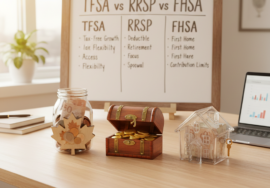
An FHSA is a dedicated savings account for Canadians who are planning to buy or build their first home. It combines the best tax features of RRSPs and TFSAs:
- Contributions are generally tax-deductible, reducing your taxable income.
- Qualified withdrawals (for a first home purchase) are tax-free, including any investment growth.
This means you save tax when you put money in — and pay no tax when you take it out to buy your first home, as long as the rules are followed.
Who Can Open an FHSA?
To qualify for an FHSA, you must:
- be a Canadian resident
- be 18 years of age or older
- be a first-time home buyer (you can’t have owned a home you lived in before)
This account is specifically for individuals who haven’t yet purchased and lived in their own home — in other words, your first home.
Contribution Rules: How Much You Can Save
Here’s how saving room works:
Annual Contribution Limit
- You can contribute up to $8,000 per year.
Lifetime Limit
- The total lifetime contribution limit is $40,000.
Carry Forward
- If you don’t use all your annual contribution room, you can carry it forward to future years — up to a max of $8,000 per year.
You can have more than one FHSA account, but all contributions combined must stay within the total annual and lifetime limits.
Tax Benefits — The Heart of the FHSA Advantage
- Tax Deduction
Contributions to your FHSA can be claimed as a deduction on your income tax return in the year you make them. This works just like an RRSP deduction, lowering your taxable income. - Tax-Free Growth
Money inside your FHSA — including investment income like dividends and capital gains — grows tax-free. - Tax-Free Withdrawals
When you take money out of your FHSA to buy or build your first qualifying home, that withdrawal (including growth) is completely tax-free.
This powerful tax combination makes the FHSA one of the most effective tools for getting ahead on your first home purchase.
Using Your FHSA to Buy a Home
To make a qualified withdrawal (and keep it tax-free):
✔ You must be a first-time home buyer
✔ The money must be used for buying or building a qualifying home in Canada
✔ You need a written agreement to buy or build the home by October 1 of the year after you made the withdrawal
✔ You must live in the home as your principal residence within one year of the purchase or build date
Once you make a qualifying withdrawal, your FHSA must be closed by December 31 of the year following that withdrawal. Any remaining funds must either be transferred to an RRSP or RRIF (tax-free) or withdrawn (which may trigger tax).
What Happens If You Don’t Buy a Home?
If you end up not using your FHSA for a first home purchase by the time it must be closed (usually 15 years after opening, or in the year you turn 71):
1. Transfer to RRSP or RRIF
- You can move the funds tax-free into your RRSP or a Registered Retirement Income Fund (RRIF), even if you already have an RRSP.
2. Withdraw and Pay Tax
- If you withdraw the FHSA funds instead of transferring them, you must include that amount as income on your tax return.
This means unused FHSA savings don’t just disappear — they can still be used for retirement savings.
Transfers From RRSPs to FHSAs
You can transfer funds directly from an RRSP to your FHSA — which can help boost your FHSA savings without paying tax on the transfer. However:
- the transferred amount does not count as a deduction from your FHSA contribution limit, and
- it uses up FHSA contribution room for the year.
This option gives extra flexibility in deciding how to use your registered savings.